On a Saturday evening in Rotterdam, the Netherlands delegation of the Knights of Alba gathered for a chapter to welcome new members. Every chapter has a cultural moment, and this one was rich.
The mayor of Alba, Alberto Gatto, spoke first. He presented Le Fabbriche del Vento, Alba's programme as Italian Capital of Contemporary Art 2027. It will carry art across the UNESCO territory, into chapels, villages and vineyards, and leave behind a lasting Biennale delle Langhe.
Silvia Principi, Administrative Chancellor at the Italian embassy in the Netherlands, spoke next about la cucina italiana. In December 2025, UNESCO inscribed Italian Cuisine as intangible heritage of humanity, under the title "between sustainability and biocultural diversity". What it recognised is a practice rather than a menu: grandparents teaching grandchildren, recipes made to waste nothing, respect for ingredients, the shared moments around a table. Italian cooking, she reminded us, carries more than recipes. It carries the values Italians share.
Then it was my turn, as a member of the order's ruling council.
I began with thanks. Those of us who work for the order in Alba do so as volunteers, and a room so full of committed members means more to us than people imagine.
Then I picked up the word everyone had been using all evening: UNESCO.
More than monuments
Say UNESCO and most people picture a cathedral, a fresco, a museum. Something you visit, photograph and leave behind. Much of what binds the Knights of Alba is of another kind. It lives in people.
Italian has an expression for it: saper fare e far sapere. Knowing how to do something, and making it known. The first half is craft. The second is transmission. Heritage survives only when both are present.
Four threads
Four UNESCO recognitions meet in our order.
The vineyard landscape of Langhe-Roero and Monferrato is inscribed as a cultural landscape, the joint work of nature and people. Its hills record centuries of patient decisions about which grape belongs on which slope.
Within it stands the castle of Grinzane Cavour, recognised in 2014 as one of the six components of that inscription. In the nineteenth century, Camillo Benso, Count of Cavour, made it a centre of the first modern winemaking experiments in the Langhe, work that helped Barolo become what it is.
Truffle hunting is a bond between a person, a dog and the woods. It passes from father to son, from mother to daughter, through nights walked together far more than through books.
And Italian Cuisine, recognised as a culture as a whole. Its value lies in the ingredients, the gestures, and the table where a family sits down together.
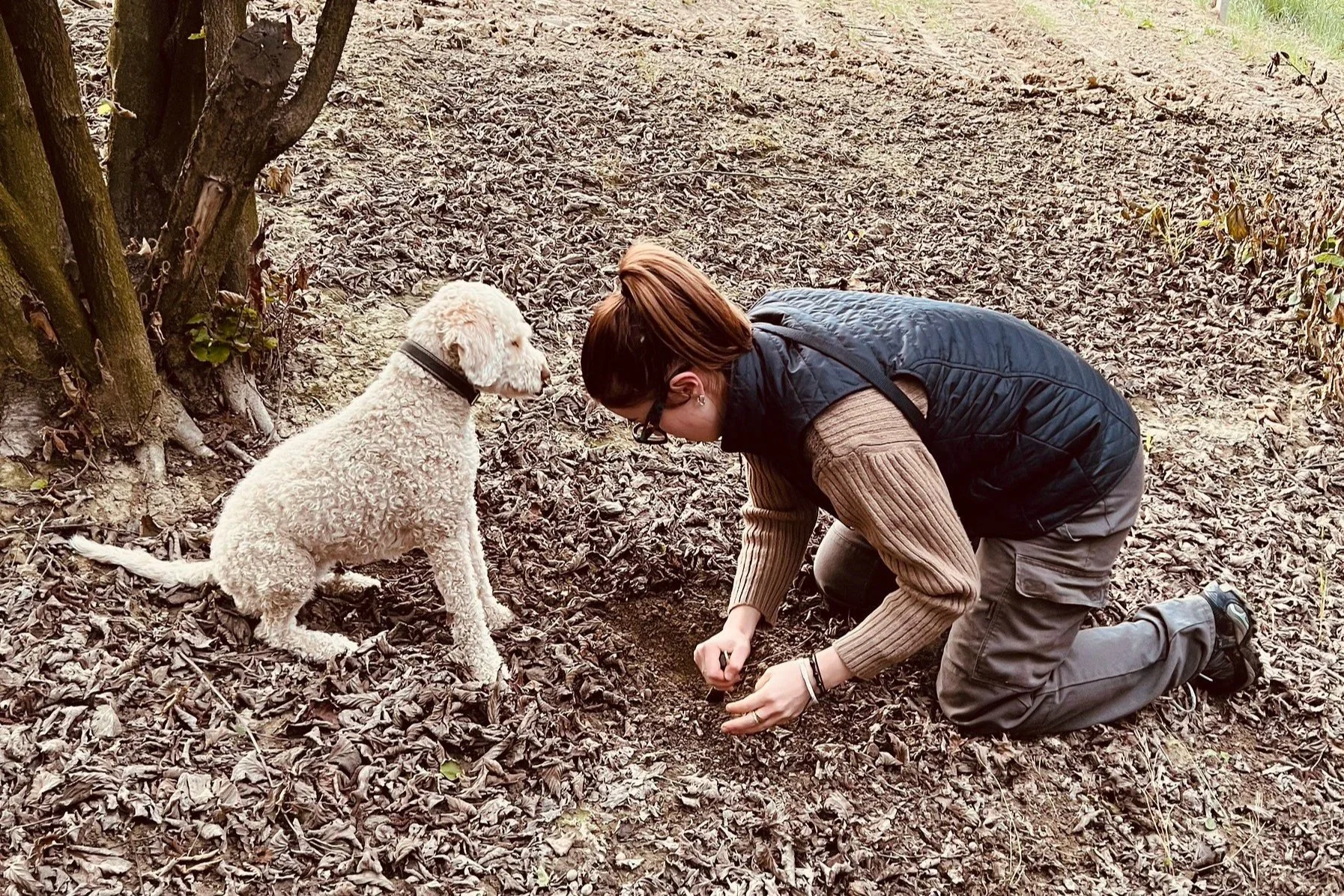
Photo by JC Viens - Truffle hunting is a bond between a person, a dog and the woods.
Inheriting, then reworking
Tradition belongs to the past by definition. The question is how to carry it forward without letting it grow heavy.
Each generation that receives a tradition also changes it. A new technique in the cellar. A new dish from old ingredients. A young hunter who learns from his grandfather, then trains his dog his own way. That ingenuity is part of the heritage too. The landscape of the Langhe exists because people kept adapting to it, season after season. Alba's 2027 programme comes from the same instinct. Its emblem is the small chapel in the Brunate vineyards at La Morra, painted by Sol LeWitt and David Tremlett. The building stayed modest and the vineyard stayed around it. Only the colour changed how people see it. As the mayor put it that evening, a great cultural landscape is not something we inherit passively. It is something we continue to create together.
The part the knights play
This is what I wanted the room in Rotterdam to hear. A Knight of Alba is never only a spectator.
Every trip back to Alba, every evening at Grinzane Cavour, every question put to a truffle hunter, every bottle opened and explained to a friend abroad is far sapere in practice. Interest is what keeps intangible heritage alive. It is also what tells those who protect it that it still matters.
Wherever a knight lives, in Rotterdam, Hong Kong or anywhere else, they are part of this.
So I ended where I began, with thanks. For being there that evening, and for keeping these traditions alive simply by caring about them.
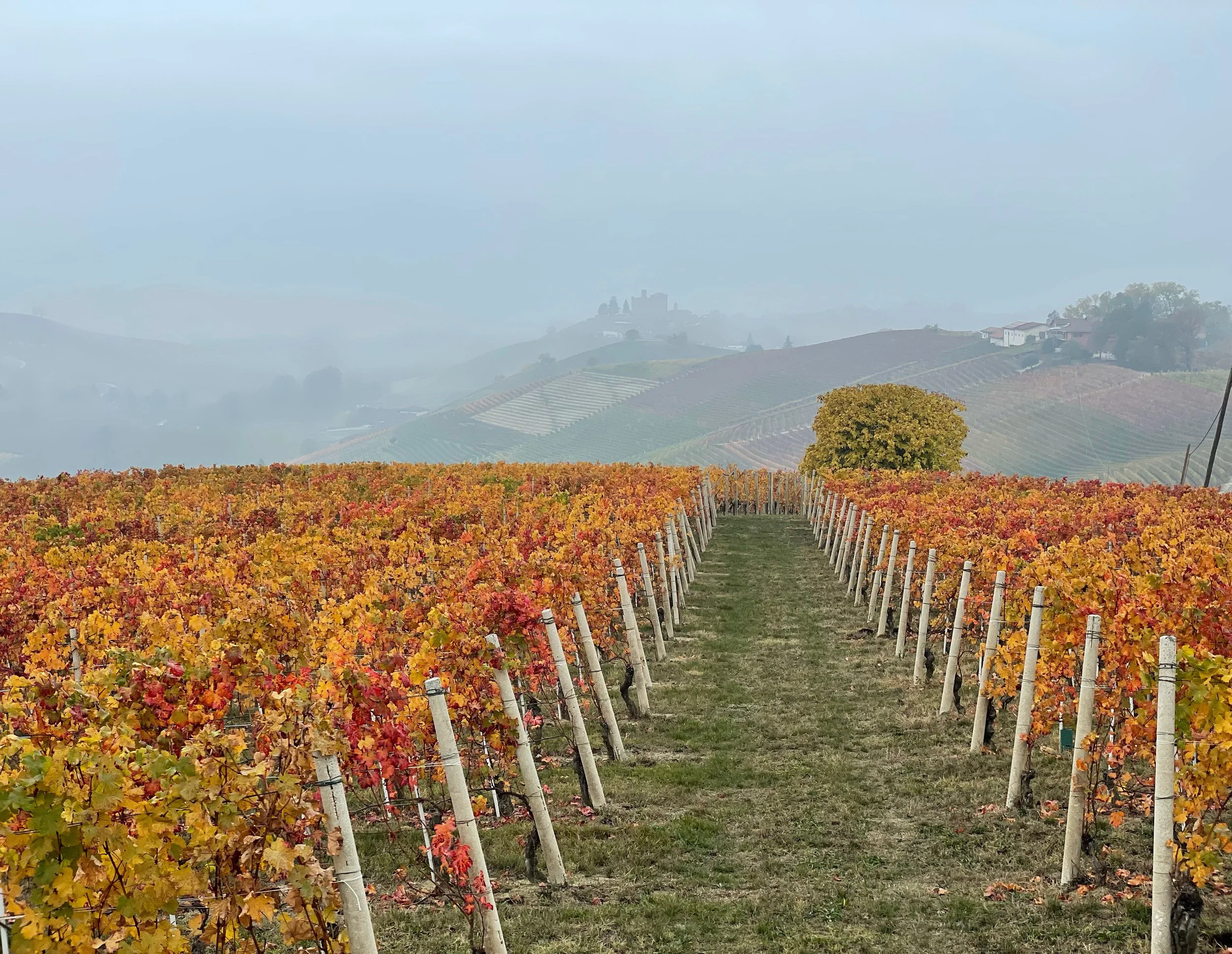
Photo by JC Viens - The hills of the Langhe with the Castel of Grinzane Cavour in the ‘nebbia”