
When I was maestro of the Hong Kong delegation of the Knights of Alba, I launched an initiative with a local importer. At the start of our annual white truffle chapter, we set up a white truffle market, so members could buy as much truffle as they wanted, shave their heart out during the dinner, and even keep some for breakfast the next day.
We wanted to bring the famous white truffle market of Alba to Hong Kong, with as much of its atmosphere as we could: the tablecloths, the scales, truffles of various sizes and different prices.
Bought in the room and shaved the same evening, a white truffle gives everything it has. Tuber magnatum Pico is prized almost entirely for its aroma, and the aroma begins to leave from the moment the truffle comes out of the ground. Everything worth knowing about buying, keeping and serving one follows from that.
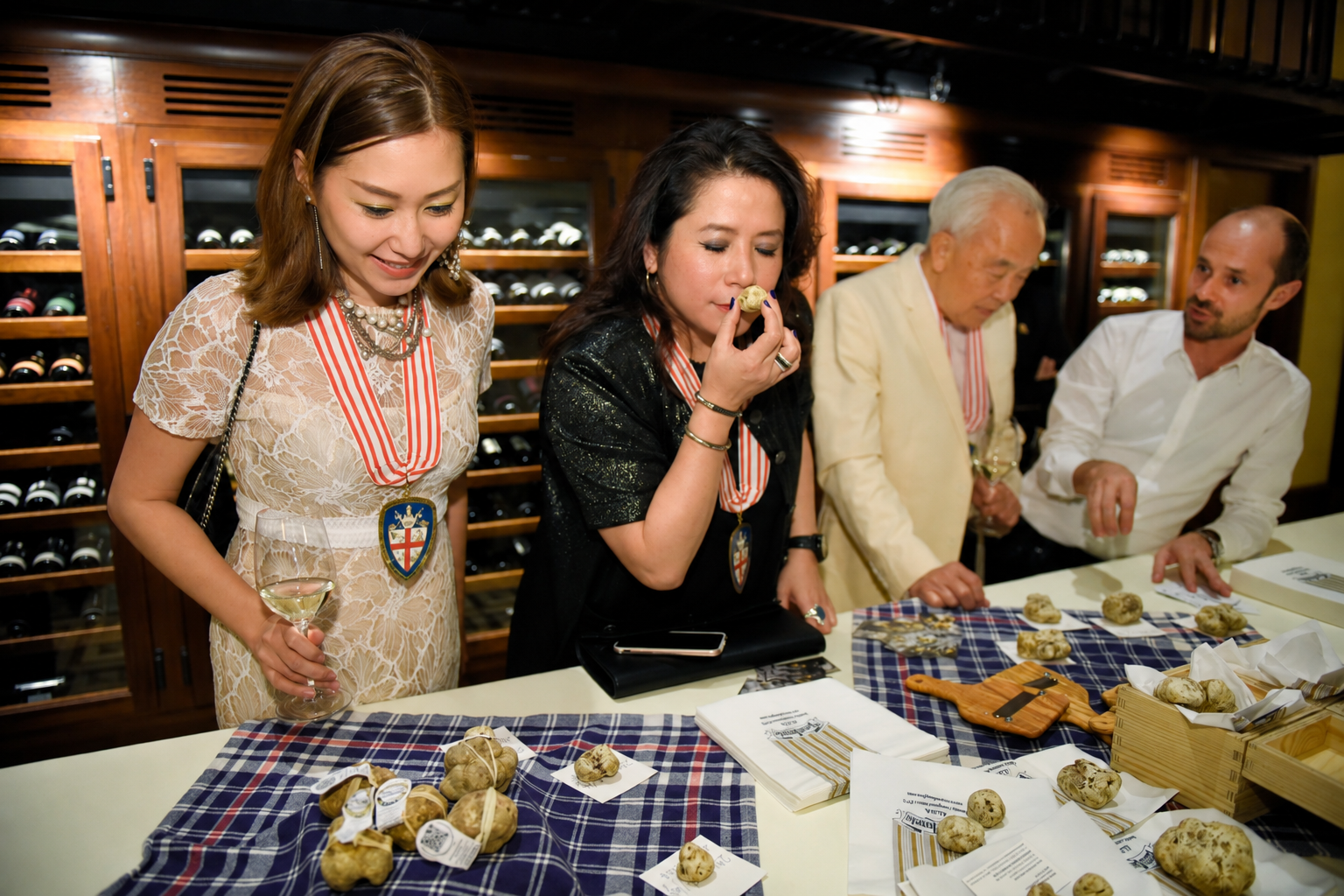
Photo by Ali G - White Truffle Market at a Knights of Alba Chapter in 2019
Why it costs what it costs
The white truffle grows wild, underground, living in partnership with the roots of trees such as oak, poplar and hazel. A trained dog finds it and the hunter digs it out by hand, a practice UNESCO added to its list of intangible cultural heritage in 2021.
Farming it is still an experiment. French researchers harvested the first white truffles from a planted orchard in 2019: three that year and four the next. Supply still depends on the woods and the weather. This autumn a dry summer gave a slow start, and by mid-November white truffles at Acqualagna, in the Marche, sold for about €2,000 a kilo for small pieces and €3,000 to €4,000 for the finest.
What that money buys is perfume, and the perfume is unstable. Scientists who followed fresh white truffles in storage found their aroma changing markedly as the bacteria living inside them multiplied. Most of what we call flavour reaches us through the nose, which is why a white truffle loses much of its charm with every day it waits.
Where to find it
"Tartufo bianco d'Alba" names the species. It says nothing certain about where a truffle was found. Italian law allows Tuber magnatum Pico to be sold as the white truffle of Alba or of Acqualagna, and it grows in the Langhe, Roero and Monferrato, in the Marche, Tuscany, Emilia-Romagna, Umbria, Lazio and Abruzzo, and across parts of the Balkans. Some of what is sold in Italy comes from abroad; when it is resold, its foreign origin must be stated on the label.
The national season runs from 1 October to 31 December, and regions can adjust it: in Piedmont it runs to 31 January. A "white truffle" offered in spring is most likely bianchetto, Tuber borchii, a smaller and cheaper species with a more garlicky smell.
The easiest place to begin is a market where truffles are checked. At the Fiera Internazionale del Tartufo Bianco d’Alba in Alba, sensory judges trained by the Centro Nazionale Studi Tartufo select the truffles on sale; this year the fair runs on weekends until 6 December. Elsewhere, buy from someone you trust and ask where and when the truffle was found. A truly fresh truffle is usually local.
How to choose one
Smell it first, and take your time. A good white truffle smells strong, clean and pungent, with notes the experts describe as honey, hay, garlic, mushroom and spice.
Then hold it. It should feel firm with a slight give, velvety under the fingers, and heavy for its size. Shape does not matter: a knobbly truffle can be as good as a round one. Choose one that is whole and clean.
The red flags:
A smell of ammonia, which means the truffle is overripe, old or badly kept.
Softness, sponginess or a rubbery spring when pressed.
Holes and deep scratches on the surface.
A vague answer about origin, or a white truffle sold out of season.
Keeping it, briefly
Eat it as soon as you can. If you must keep it, wrap it in absorbent kitchen paper, put it in a closed glass jar in the fridge at 3 to 6°C, and change the paper every day. A week is the outer limit.
Keep it out of rice. Rice draws out the moisture, and a sensory judge at Alba told Gambero Rosso that you end up with fragrant rice and a truffle like a piece of cork.
Clean it only just before serving, with a soft brush and, if needed, a quick rinse under cold water, then dry it. Let it sit at room temperature for about fifteen minutes before slicing. Cold mutes it.
How to enjoy it at its best
Raw, sliced very thin at the table, over something warm, plain and rich in fat. The warmth lifts the scent, and the fat holds it. Tajarin with butter, an egg with a soft yolk, white risotto, fonduta, raw veal. About ten grams per person is generous.
What not to do: do not cook it, because heat drives the aroma away. Keep strong spices and bold flavours off the plate. And leave truffle oil, salt and butter aside. Most are flavoured with a synthetic version of bis(methylthio)methane, a compound found in the white truffle itself, which gives one note the scent of many.
Choose a wine from the same hills. Older Nebbiolo has notes of earth and dried leaves that sit well beside it. At Piazza Duomo in Alba, with a small fonduta and white truffle, an aged Ceretto Barbaresco Gallina, and I was in heaven.
Buy the truffle as close as you can to the day you will eat it, and shave it generously.
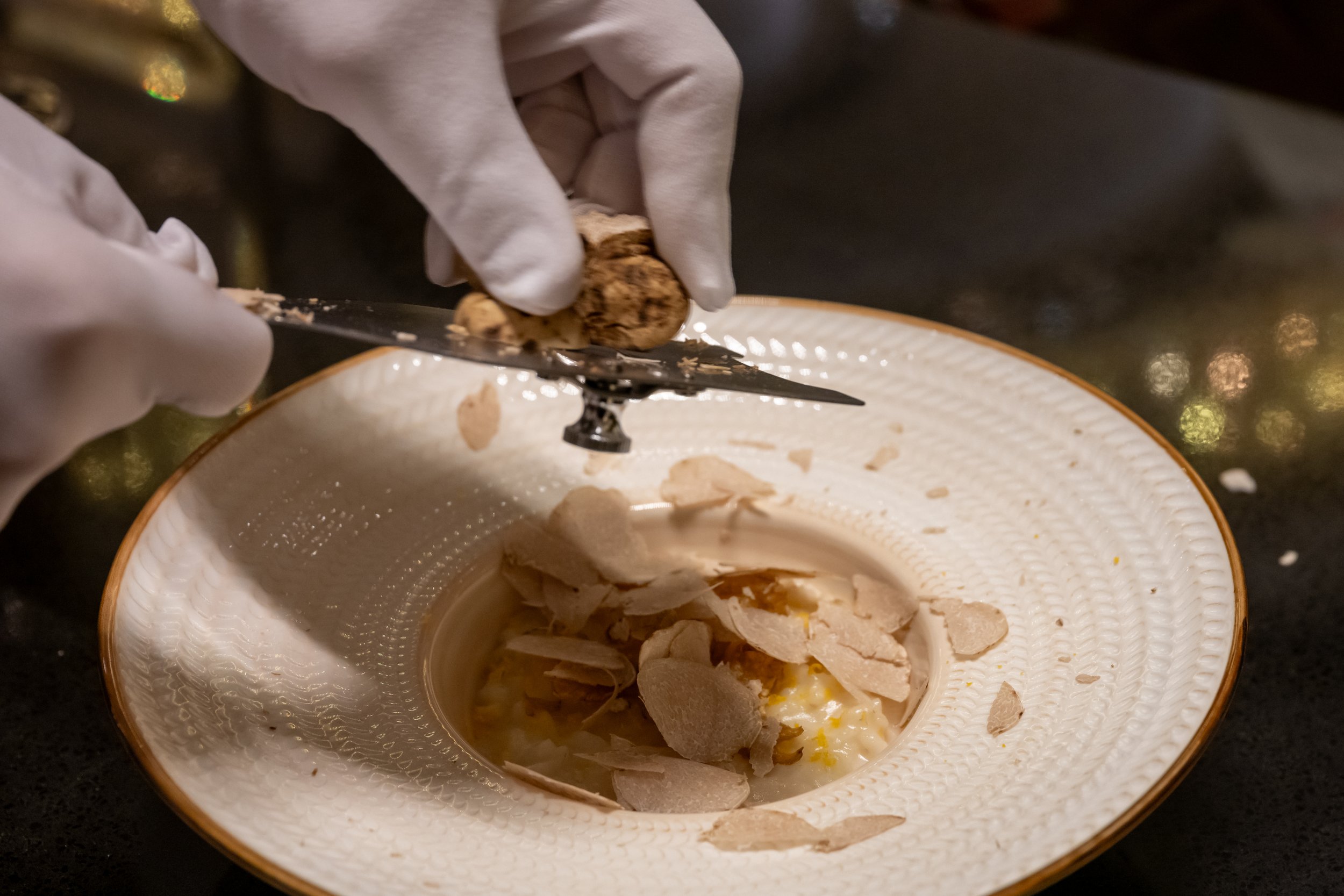
Photo Keith Sin - White Truffle Shaved on Plain Dish