Photos by JC Viens
A wine family's restaurant
The entrance is easy to miss. A red door on a side street, a few steps from Piazza Risorgimento and the Duomo. Upstairs, a dining room painted pink, its walls frescoed by Francesco Clemente, its windows looking out over the square.
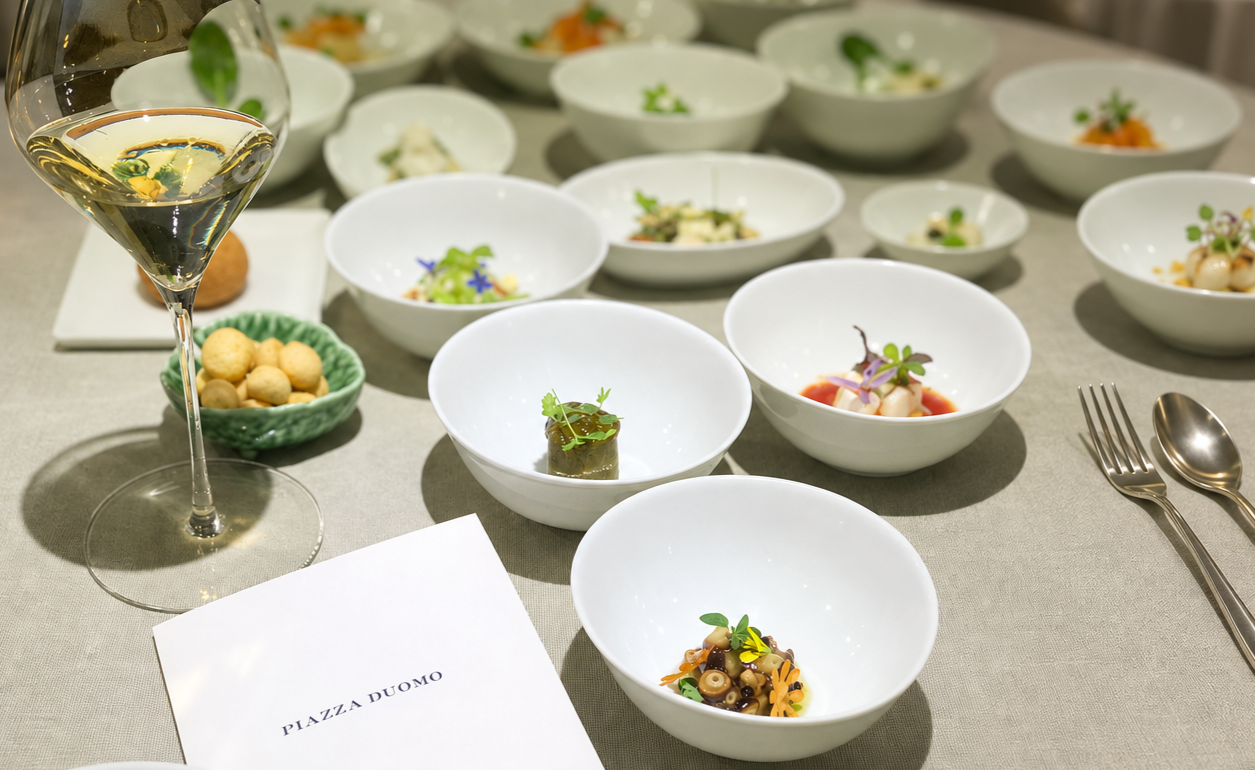
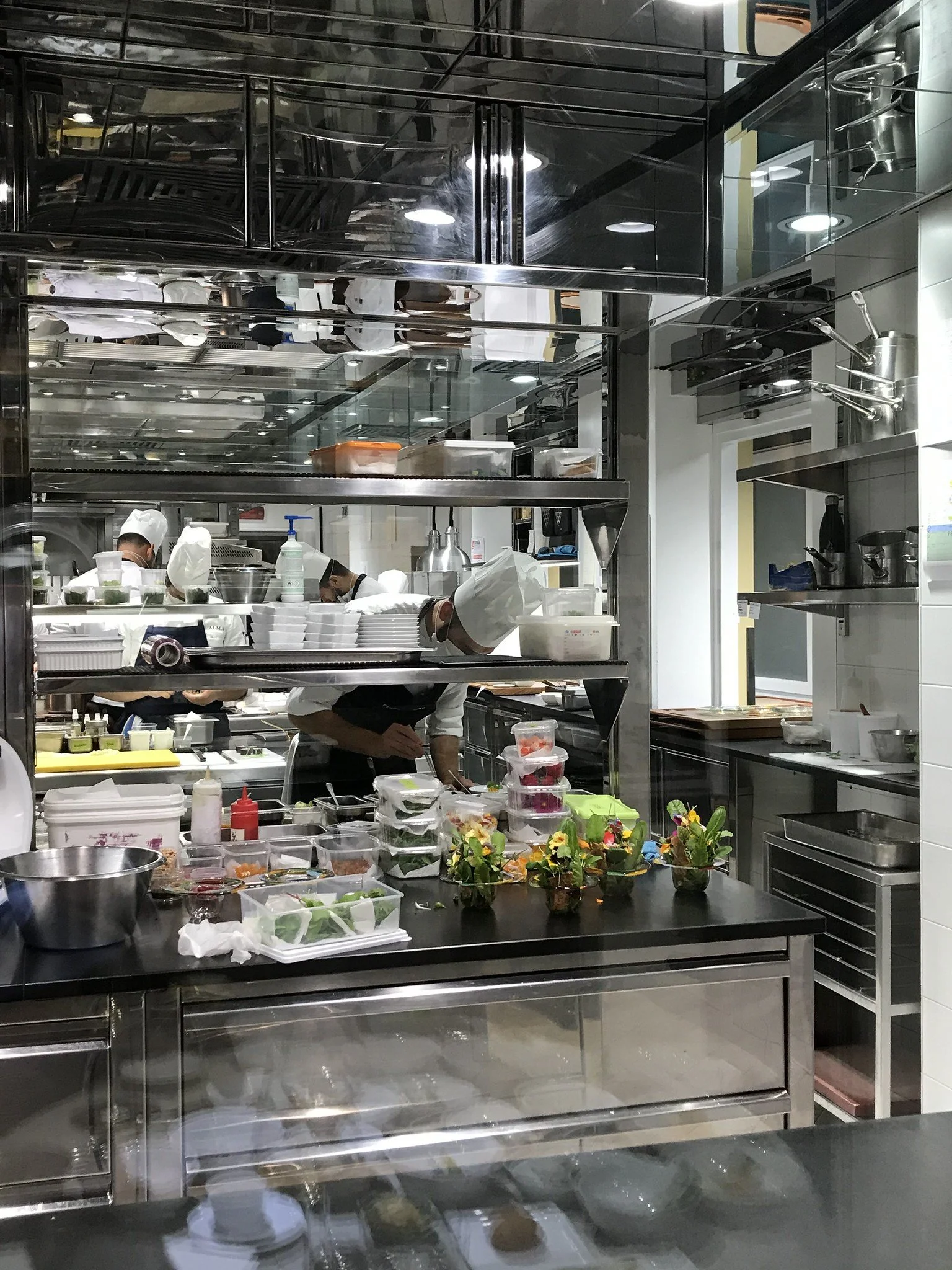
There is another way in. Guests at the kitchen table are led through the kitchen itself, past the ovens and the cooks setting up for service, to a glass room at the very deep end. From there you see the stoves, the pass, and the station where the salad is built. It feels like being let into a secret.
The restaurant belongs to the Ceretto family, who have made Barolo and Barbaresco here for three generations. Bruno Ceretto met Enrico Crippa in 2003, over a savoury brittle with malghesino cheese. They opened Piazza Duomo together in 2005.
The family brings the land, the cellar and a long love of contemporary art. The garden sits on Ceretto land, and Crippa has cooked menus in honour of the artists they exhibit. He brings a language entirely his own. Roberta Ceretto has said that all of his inspiration comes from what he can grow and find in that garden.
They have worked together for twenty-one years. In this world that is rare, and you can feel it in the room: nothing at Piazza Duomo looks hurried, and nothing looks borrowed.
Most of what is written about Piazza Duomo is about the garden: the leaves, the flowers, the famous salad. Very little is about the cellar. Yet this is a kitchen owned by winemakers, and I find it easiest to understand through their wine.
What great Barbaresco teaches
Ceretto is best known for its Barolo. The wine of theirs I love most, though, is a Barbaresco: Gallina, from Neive.
In a great Barbaresco, purity means transparency. You taste the hill, the year, the grape, and very little of the winemaker's hand. The precision is there, but it never forces. The best wines carry energy rather than weight.
Gallina is my favourite of Barbaresco's named vineyards for exactly this. Ceretto's is tender and delicate, yet it has a lovely uplifting energy.
What follows is my reading, not Crippa's. But those three words, precision, transparency and energy, describe his cooking as well as any I know.
The garden as a cru
Crippa's garden lies at Monsordo Bernardina, on the Ceretto estate outside Alba. Organic and biodynamic, with greenhouses for the colder months. He begins most mornings there, and what is ready shapes the menus, alongside produce from growers around Alba and Barolo.
A winemaker would recognise the discipline: the site comes first, the hand follows.
Crippa trained with Gualtiero Marchesi, who sent him to Kobe, and he stayed in Japan three years. It shows. In the precision. In the respect for a single leaf. In plates that look composed rather than assembled.
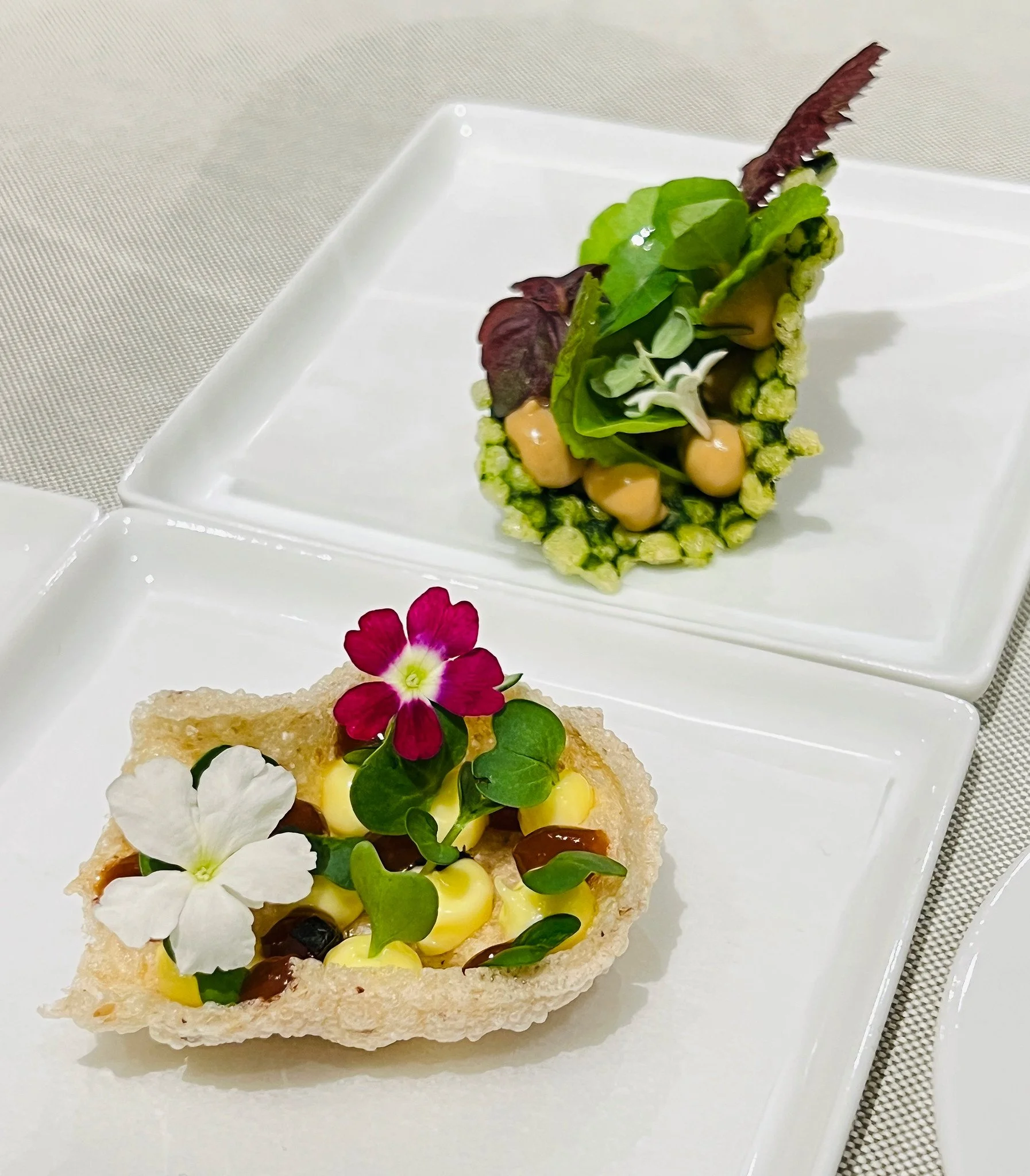
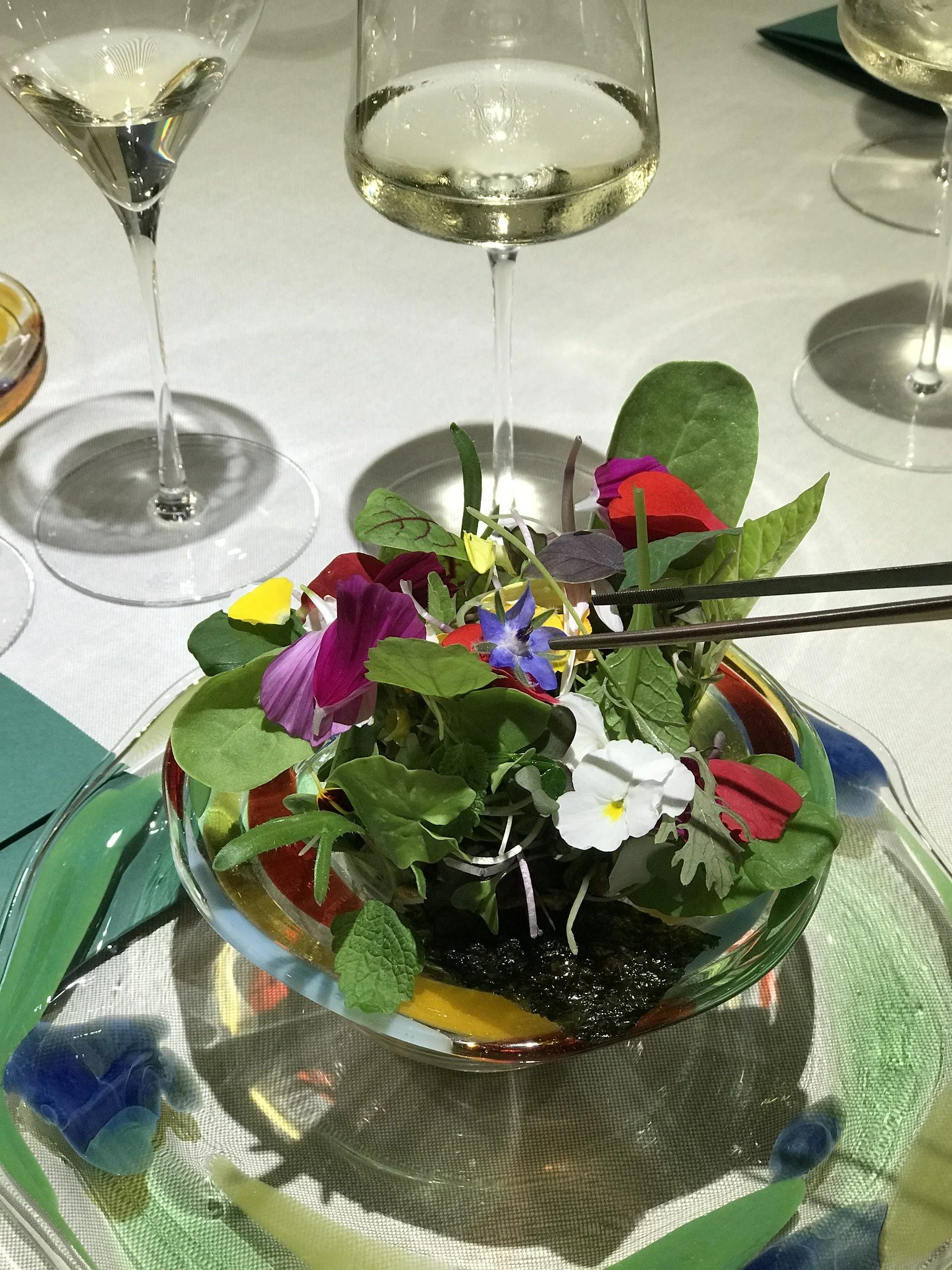
Then there is the salad, Insalata 21, 31, 41, 51, its name counting the leaves, herbs, flowers and seeds it has gathered over the years. From the kitchen table you can watch it built, one element at a time, with tweezers. Forty-one parts sounds like abundance. On the plate it is light and ethereal, as if everything had fallen from the sky and arranged itself. As in a great wine, nothing dominates and every part earns its place. In French we would say épuré: refined down to what is essential.
Where kitchen and cellar meet
I have eaten at Piazza Duomo three times, in 2017, 2020 and 2024. The moment I returned came in September 2020, at the kitchen table, celebrating an anniversary with my wife, Maria.
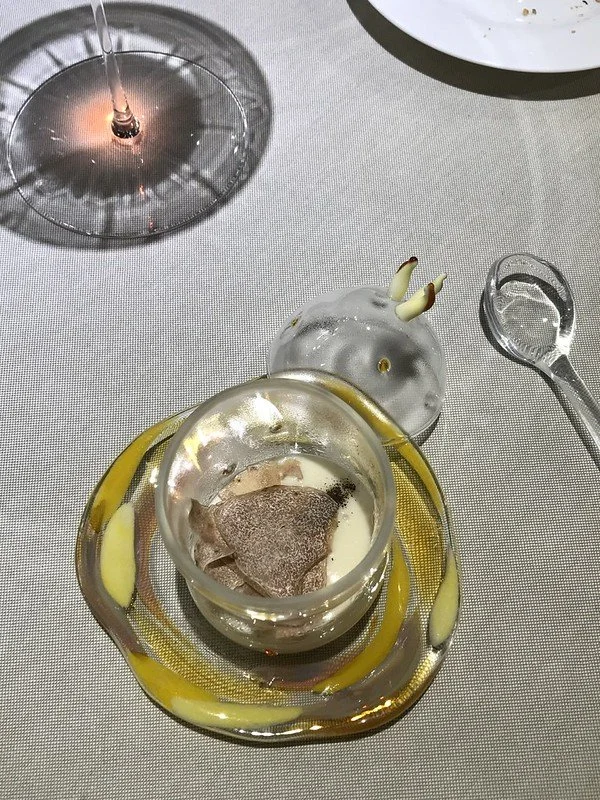
It was a small, simple dish: a reinterpretation of fonduta piemontese, with white truffle, that surprised me most. Very little in the glass, yet an explosion of flavour. With it, an aged Ceretto Barbaresco Gallina and I was in heaven.
The two did the same thing. Each was precise without force, transparent to where it came from, and full of energy rather than weight. A dish from the garden and a wine from the hill, made by a chef and a family who have shared a table for twenty-one years.
Piazza Duomo stood at No. 15 in 2017, fell as low as No. 42 in 2023, and has climbed back since; this week it reached No. 20, the highest-ranked restaurant in Italy. Lists move with fashion. The kitchen did not: its three Michelin stars have held since 2012. This year's top place went to Asador Etxebarri, a grill in the Basque hills. Perhaps purity is finding its way back. If so, it may be because, for years, we mistook it for seriousness. Seriousness is a posture. Purity is clarity, and at Piazza Duomo it arrives with colour, lightness and pleasure.