One question across the table
Last June in Milan, I booked a seat at a social table at Casa Nuvola, the home of Valentina and Marco. Ten of us sat around one long table, most of us strangers. Valentina cooked a Japanese-inspired menu. Marco poured six wines made by Japanese vignerons, from Alsace and the Loire to Burgundy, Occitania, the Val Trebbia and New Zealand.
For the first part of the evening, we were polite. Ten individuals, each holding a glass, each a little careful.
Then one guest asked a woman across the table, who had mentioned a trip to Japan over the aperitivo, what she had loved most about it. She answered. Someone added a memory of their own. A third person asked a question. Within minutes the table had changed. We were talking about the food, the wines, journeys made for a single meal, places that had stayed with us. Glasses moved. People leaned in.
What broke the ice was no famous bottle or clever pairing. It was one person's curiosity about another. The wine and the food simply gave that curiosity somewhere to go.
I have thought about that moment often since, because I believe it holds something the wine world needs to hear.
A world that has closed in on itself
The world drinks less wine than at any time in living memory. In 2024 global consumption fell to around 214 million hectolitres, the lowest level since 1961. Health, price and moderation all play their part. Yet I believe something deeper is at work: we are losing the habit of sitting down together.
Look at how we live. In Italy, one-person households are now the most common kind, 37.1 per cent of all families, against 25.9 per cent twenty years ago. Istat expects the share to pass 41 per cent by 2050. Across the European Union, single adults without children account for 75 million of 202 million households, the largest group of all.
We also spend more of our free time alone. In the United States, where time use is measured most closely, the hours people spent with friends fell from about six and a half a week in the early 2010s to under three by 2021. Among 15 to 25 year olds, in-person socialising dropped from an hour a day in 2003 to 36 minutes in 2024.
Living alone shapes how we go out. Even among friends, the reflex now is independence: each person orders their own dish, their own glass, their own drink. We sit at the same table, yet eat and drink in parallel. Wine, made to be shared from one bottle, becomes one more private choice.
The wine world has added its own barriers. Wine is too often presented as a test of the right words and the right opinion. Tastings have become transactional: a pour, a score, a sale. And younger drinkers have drifted, though not as we assume. IWSR found more Gen Z adults drinking alcohol in 2025 than two years earlier, while Meininger's analysts observe that wine lacks a natural place in the occasions where they gather.
The social table answers all of this at once. One menu, the same bottles poured for everyone, the choice taken out of our hands. What remains is the thing we have been missing: sharing.
The open table
In Paris and elsewhere there is a fashion for private wine clubs, with fees running to thousands of euros a year, waiting lists and evenings in hotel salons. Le Figaro has reported members using them as tools for public relations. Whatever their merits, they rebuild the very thing that keeps people away from wine: a door most cannot open.
The social table works the other way. Anyone can book. You arrive alone or with one friend, sit where you are placed and eat what the host has chosen. Nobody knows your job, your income or how many wines you have tasted. The menu is fixed and the wines are poured for you, so the only thing left to do is talk.
At Casa Nuvola, nobody knew what I do for a living. I made sure of it. I said nothing about vintages or winemaking and let others find their own words for what was in their glass. It was elating. I heard people describe wine through memory and feeling, without waiting for anyone's permission. For one evening I was simply a guest, and I learned a great deal by listening.
Where to begin
Italy's social tables are scattered and mostly found through Instagram and word of mouth. Here are three very different ways in.
Casa Nuvola, Milan. A home. Valentina, who grew up in Japan, and Marco, who is Sardinian, open their kitchen for communal dinners paired with natural wines, with themed evenings like the one I attended.
Ma' Hidden Kitchen, Milan. A loft. Founded in 2012 by Emanuele Nardoni and Melissa Arroni, it is one of Italy's longest-running supper clubs, with strangers seated together around a shared table.
Supper Segreta, Puglia. A travelling table. Francesca Madaro and Francesca Longo host dinners among perfect strangers in little-known places, and have since taken the format to Naples, Milan, Rome and New York.
To find others near you, search for “supper club”, “social dining” or “cena tra sconosciuti” with the name of your city.
A small table, a real difference
None of this will rescue the wine world on its own. A table of ten is small. But the way people drink has always changed in small places first: a bar, a cellar, a kitchen. Each evening like this sends ten people home with a new acquaintance, a wine they would never have chosen and a better story about wine than the one they arrived with. Some of them will go on to host their own.
So my invitation is simple. Book a seat at a table where you know no one. Leave your expertise, or your lack of it, at the door. Ask the person opposite you a question, and see where it leads.
Good food. Good wine. Good people. And that quiet magic of strangers becoming a table.
Sources
Less elitism, more value: can wine win over Generation Z?, Drinks+
Gen Z not shunning alcohol as much as thought, Decanter (IWSR)
Wine & Business Club founder on wine as public relations, Paperjam
One person in three lives alone in Italy, Milano Finanza (Istat)
Istat: single-person households will be 41% by 2050, ItaliaOggi
1.7 million unspoken words, Association for Psychological Science
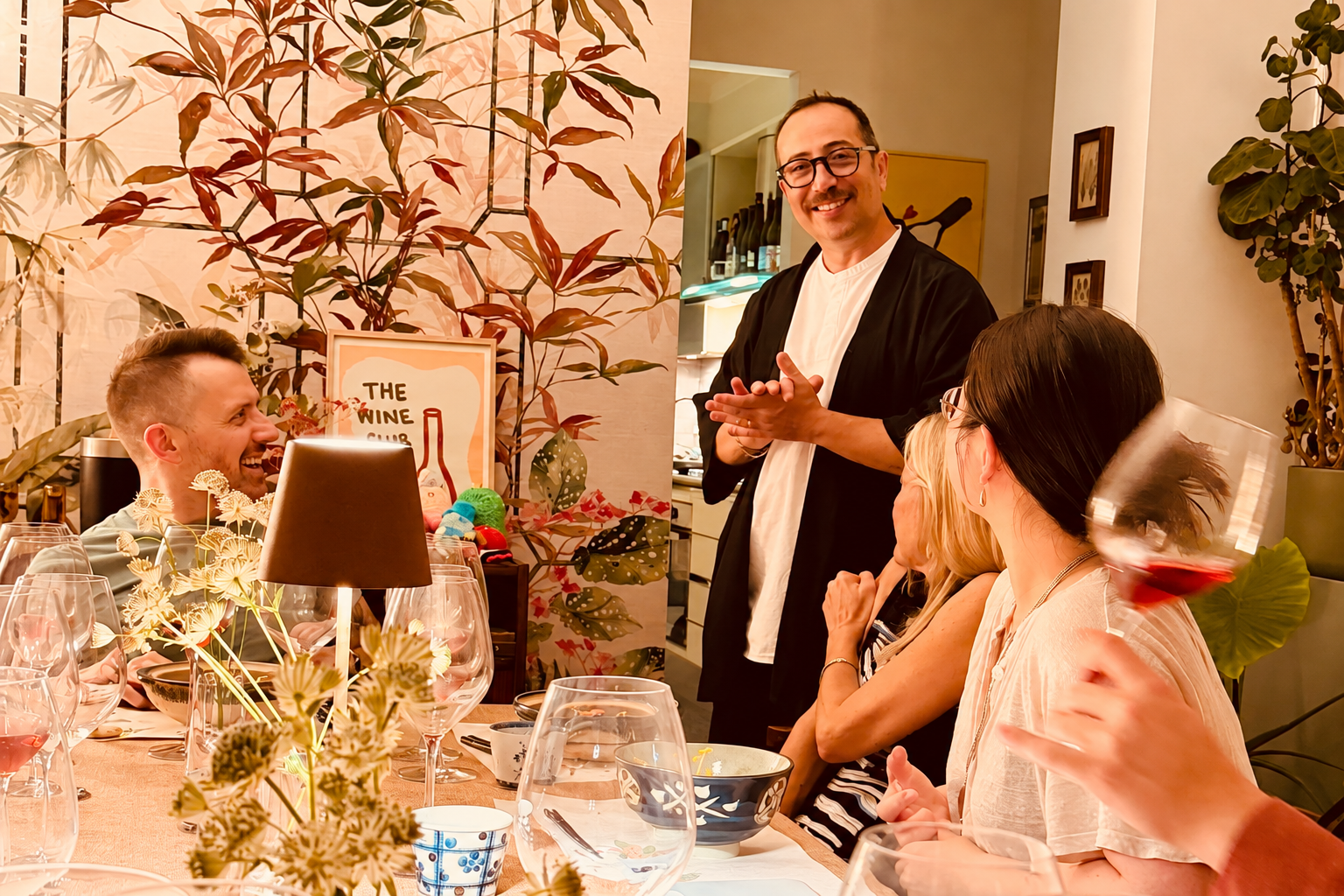
Photo JC Viens