Two maps
During a masterclass in Amsterdam, I put two maps of Italy side by side on the screen. Both were crowded with colour. Both were cut into dozens of small, irregular pieces, with borders that wandered over hills and stopped at rivers.
As the one on the right was clearly a map of Italy’s wine appellations, I asked the room what the map on the left showed. Nobody answered. It showed the dialects still spoken in Italy today.
I show these two maps whenever I teach Italian wine outside Italy. Of everything in the class, it is what people remember most.
A mother tongue
A dialect, in Italy, is a language in its own right, and often a mother tongue, the first language a newborn hears, spoken by a mother or a grandmother long before school brings standard Italian. So it carries tenderness: the voice of someone who cared for you and held you when you were small. It also gives you a sense of where you come from.
The dialects are fading, but they are still here. In Istat's latest survey, about four Italians in ten still use dialect in at least one part of their lives, mostly at home.
That is why the comparison stays with people. Everyone has a mother tongue, whatever language it was, so everyone recognises what the dialect map records. Seen beside it, the wine map reads as a record of communities too.
When I was studying for the Master of Wine, this was the research paper I wanted to write. I never wrote it, but I still teach it.
Where the lines meet
The parallel is clearest in a few places.
In the north-east of Sardinia, people speak Gallurese, which is closely related to Corsican. Vermentino di Gallura is made almost entirely in that area; a few villages within it, including Monti and Berchidda, speak Logudorese Sardinian.
Between Parma and Rimini, Emilian gives way to Romagnol, and the wine changes with it. Lambrusco belongs to Emilia. Sangiovese and Albana di Romagna are from Romagna. Bologna sits close to the line on both maps.
In the south, one grape makes two wines. Aglianico gives Taurasi in Irpinia, in Campania, and Aglianico del Vulture across the border in Basilicata. On the dialect map I use, drawn by Antonio Ciccolella, Irpino and the dialects of the Vulture are separate areas. One grape, two ways of speaking, two wines.
Laid over each other, the two maps overlap in places and part ways in others. Some of the clearest departures are recent appellations that cross old regional lines, such as Prosecco DOC, established in 2009 across Veneto and Friuli.
The two maps have a common ancestry. Both grew up, in part, inside the same old borders: the Venetian Republic, the Papal States, the Kingdom of Naples, and the Kingdom of Savoy, which once reached from Piedmont to Nice. People lived and traded within those lines for centuries, and that history left its mark on both the speech and the wine.
In Verona the dialect keeps a proverb, recorded by Andrea Brugnoli in Verona illustrata a tavola: del màs-cio no se buta via gnente, of the pig, nothing is thrown away. Ripasso is the same habit in a glass. Young Valpolicella is passed back over the skins of Amarone and takes depth from what the other wine left behind, as I wrote after a Secondo Marco Ripasso in San Zeno.
A map worth learning
Italian wine is often called difficult. There are hundreds of appellations and hundreds of native grapes, and labels that name a village where you expected a variety. Newcomers are warned that it can feel overwhelming.
I see it differently. Italian wine is complicated for the same reason Italy speaks in so many dialects. Both were made by people, valley by valley, over centuries. Asking Italian wine to simplify would be like asking Italians to give up the language their grandmothers spoke to them.
Wine begins with pleasure, and it should. A bottle can also take you somewhere. Its vintage makes it a small time machine, back to one year and its weather. Its place makes it a small travelling machine, taking you out to a hillside, to a people, and to the way they speak.
We should speak about soil, grapes and winemaking. We should never forget about culture.
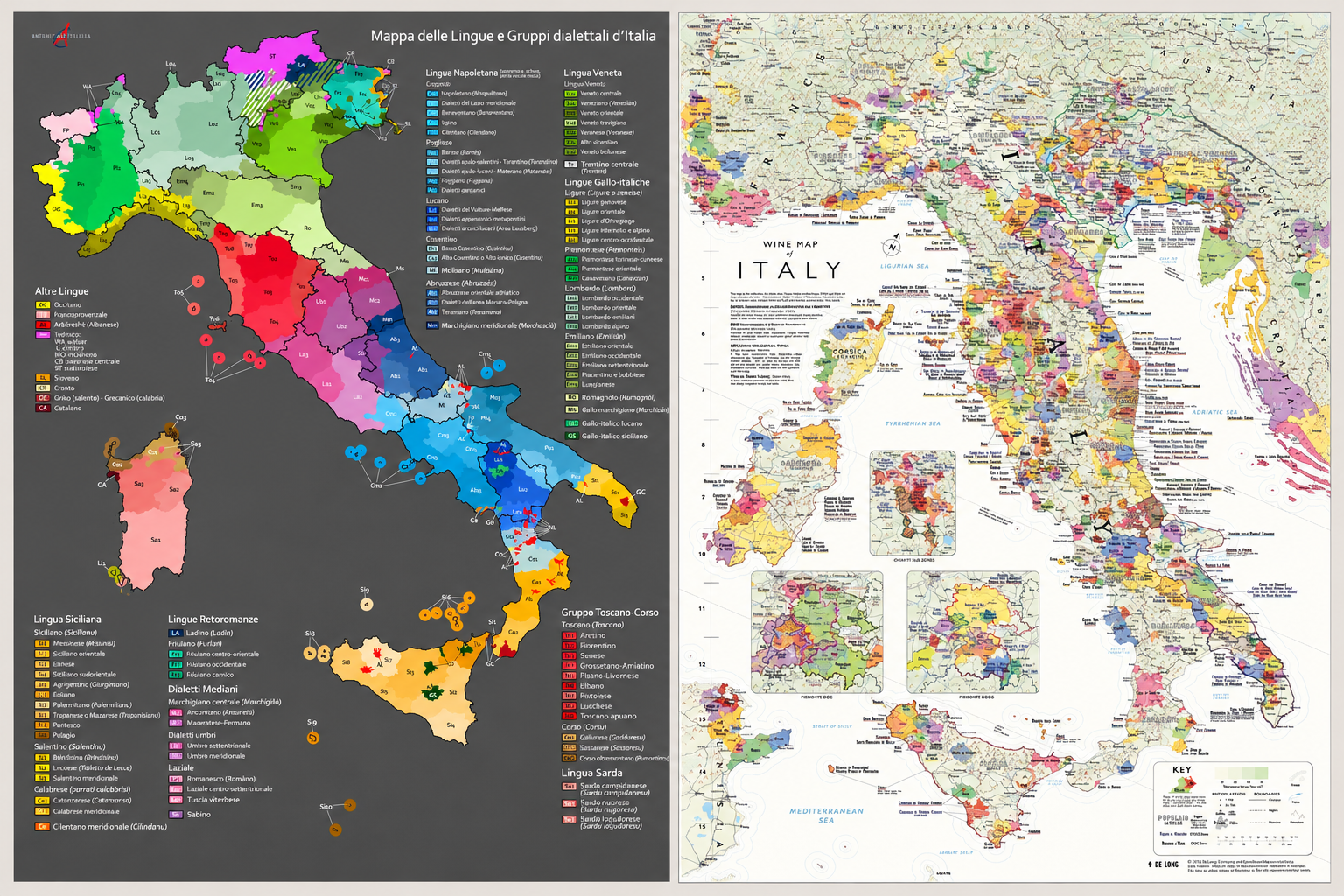
On the left: Dialect map: Antonio Ciccolella, Mappa delle Lingue e Gruppi dialettali d'Italia (2015), Wikimedia Commons, CC BY-SA 4.0.
On the right: Wine Map of Italy © De Long, delongwine.com. Reproduced with permission.