An evening at the Atelier
For some time now, a group of friends has met regularly to taste, these days at my new place in Valdonega, L'Atelier del Vino. My hope is that it becomes a place where people meet to discover wines, and leave a little more sure of what they love. That evening, the wines came from China.
The nine bottles stood in a line in the window. Seven had come home in my luggage last May, after a visit to Shuffle, a wine bar in Shenzhen, where Henry Wu put the selection together. The two from Chateau Nine Peaks were sent by the winery itself, when a friend told them about our evening. The glasses carried letters, A to I, and a two-page brief lay on the table. Nobody looked at it. We tasted, argued, changed our minds, and each of us ranked all nine.
The arguments were the best part. Two friends tasted the same Syrah and came away with opposite wines. One found it clean. The other found funk on the nose and funk on the palate. "I think we are living in alternate universes," one of them said.
Then a friend who has travelled through China for work for six years said what several of us were thinking. These wines were completely different from anything he had tasted there before.
Faster than we expect
I should not have been surprised. I kept an office in Shenzhen for fifteen years. When it became China's first special economic zone in 1980, it was little more than a fishing town. Today it is home to about 17.5 million people and to companies such as Huawei, BYD and Tencent, and it has brought itself to the forefront of the world's electronics. I lived part of that story.
Even small things move at that speed. In 2019 the Starbucks at Coco Park, a few streets from my old office, had a short menu and customers buying the same drink out of curiosity. This May it was full of people lounging over a long list of drinks made for local taste. I was the only foreigner in the room.
Wine is finding those same people. Shuffle, where most of our bottles came from, is fast making a name for itself in Shenzhen. Its general manager, Henry Wu, won the 15th China Sommelier Competition in 2023. He is a sommelier of real skill and passion, and the selection he made for us showed it.
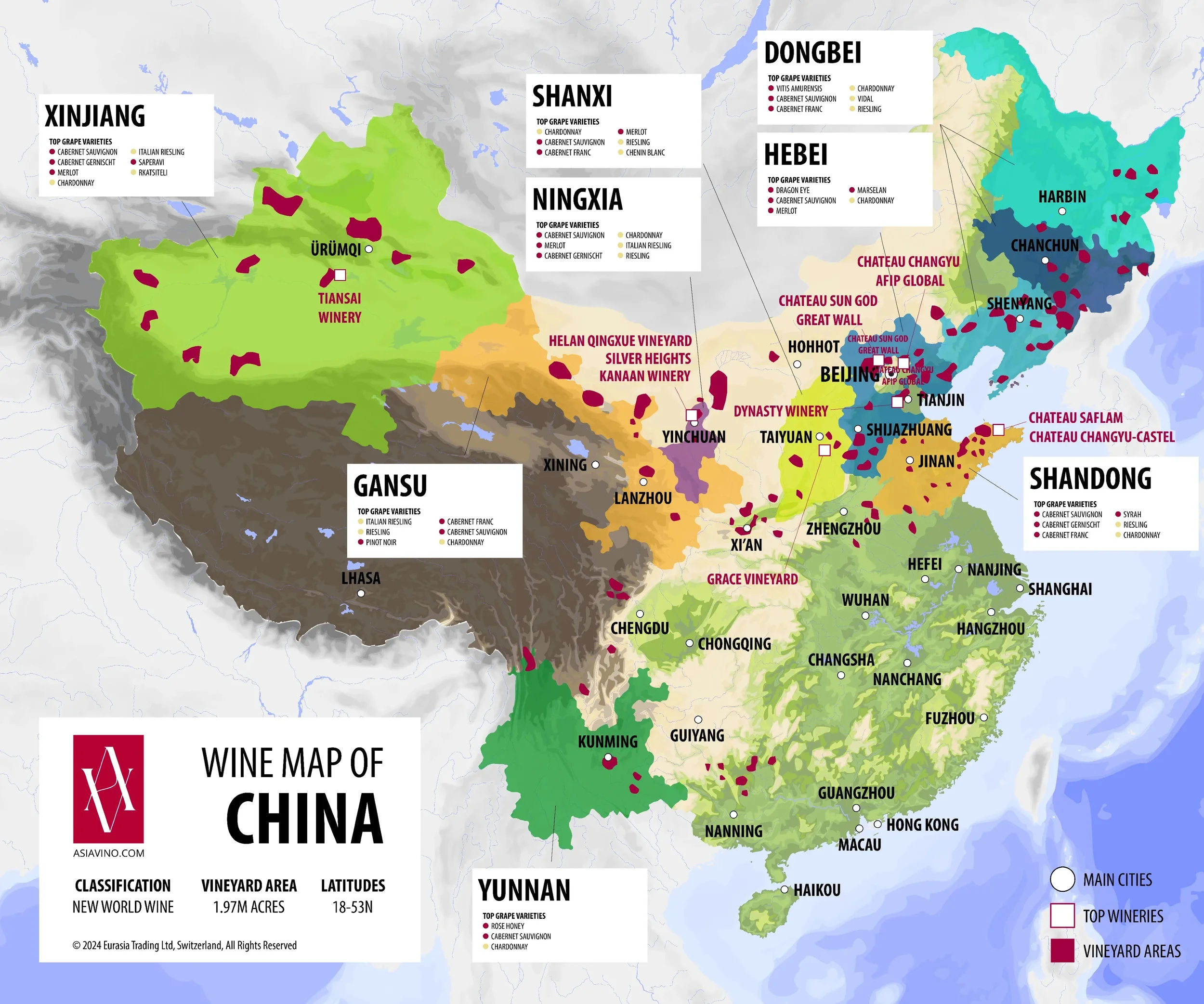
The wines themselves have moved just as fast. Grace Vineyard, one of the first family estates, was founded in Shanxi in 1997. Ningxia first caught the wine world's attention in 2011, with a top award at the Decanter World Wine Awards in London. Most of the estates we tasted are younger than twenty years. Domaine Muxin was founded in 2020.
What speed buys
Precision, first of all. Every wine on the table was clean and correct. A friend who knows wine as well as anyone I know put it simply: any of them could be slipped into a European tasting and hold its place. These are wines born from an idea, and made to match it.
The winner showed it best. Chateau Nine Peaks QI 2021, from the hills near Qingdao, is mostly Cabernet Sauvignon with Petit Verdot and a little Marselan. Its tannins were among the finest of the evening. At the end, one friend's glass was the only empty one on the table. He wondered whether that was why he had ranked it first.
The Grace Cabernet surprised the table for what it left out: no heavy colour, no sweetness, little oak. Before Covid, a friend said, you could not have sold a wine like this in China.
Longyu's Long 12 is a well-made wine; there is no question about that. But its aroma took me back to the old China, to the fruit steeped in alcohol that is served at dinner. To me it was made for a specific local taste, a little too organised. I ranked it last.
What speed cannot hurry
The wines I keep thinking about are the ones that divided us. The Tiansai Syrah, clean to one friend and funky to another. And Domaine Muxin, the most expensive bottle of the night, from three hectares high in the Yunnan mountains towards Tibet. One friend called it dirty and unbalanced. Two of us placed it first. It was poured last, which may have helped.
For such ripe fruit, it still showed great liveliness on the palate, and its tannins were the silkiest of the evening. It carries the stylistic signature of China's past, and it shows the ambition of its future. I liked that it sits on the fence. It is the one I would put in the cellar.
Perhaps disagreement is where personality begins. Precision arrived with European winemakers, equipment and vines. Character takes longer. It grows from a place, and from the people who drink its wines at home. Italy needed generations to find its own voice in its own grapes. China is moving faster than anyone expected, and on the evidence of that evening, it has already learned how to give pleasure.
The evening's ranking
An Evening With Nine Chinese Wines
L'Atelier del Vino, Verona, 18 November 2026. Seven tasters ranked all nine wines; the lowest total won.
| Place | Wine | Region | Price | Points |
|---|---|---|---|---|
| 1 | Chateau Nine Peaks, QI Red 2021 | Shandong | €75 | 19 |
| 2 | Domaine Muxin 2022 | Yunnan | €160 | 28 |
| 3 | Longyu Estate, Long 12 Cabernet Sauvignon 2019 | Ningxia | €50 | 34 |
| 4 | Chateau Nine Peaks, Cabernet Franc Collection 2019 | Shandong | €35 | 36 |
| 5 | Grace Vineyard, Tasya's Reserve Cabernet Sauvignon 2019 | Shanxi | €50 | 38 |
| 6= | Silver Heights, Jiayuan Pinot Noir 2022 | Ningxia | €45 | 39 |
| 6= | Tiansai, T35 Syrah Viognier 2021 | Xinjiang | €55 | 39 |
| 7= | Longting, Reserve Sea Breeze Petit Manseng | Shandong | €90 | 41 |
| 7= | Canaan, Chapter and Verse Mastery Pinot Noir 2019 | Hebei | €55 | 41 |
Grande Passione · grandepassione.com#wineisforpleasure
Sources: Investment Monitor, "How Shenzhen moved out of Hong Kong's shadow"; Decanter; producers' technical sheets.
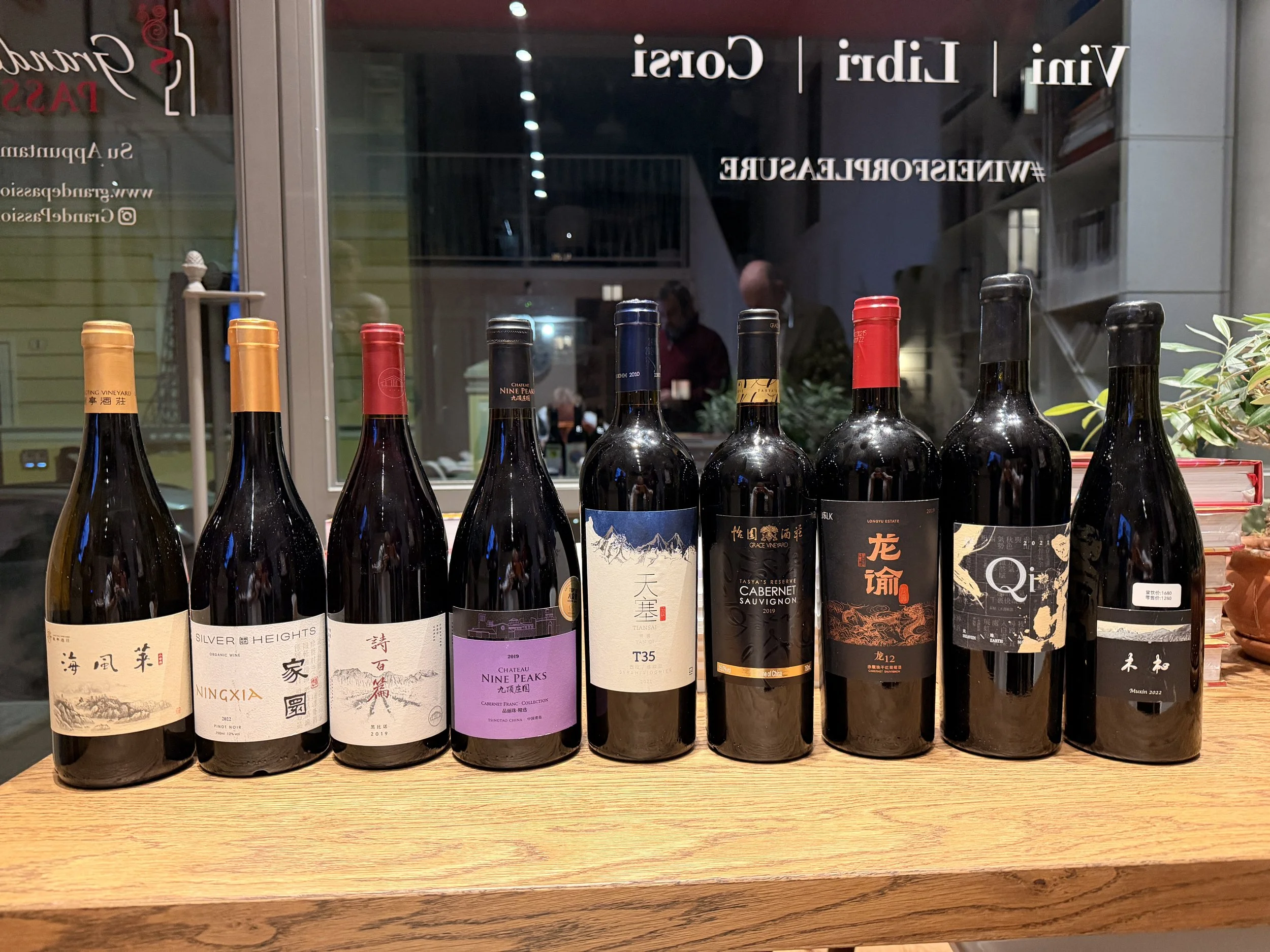
Photo by JC Viens