I always walk my guests past the crowds to Venice's oldest vineyard
Whenever friends or guests come to Venice with me, there is one walk I insist on.
We start on the Riva degli Schiavoni, in the thick of it. Gondoliers calling out, souvenir stalls, tour groups following a raised umbrella, the lagoon glittering to our right. Then we keep walking east.
Past the Arsenale, the crowd thins almost at once. The great gate with its stone lions. The long brick walls of the old shipyards. Washing hung between windows, a few Venetians with their shopping. We turn into the streets of Castello, and something happens that I have seen almost every time. My guests start to whisper, as if we had already stepped inside the church.
Then we reach Campo San Francesco della Vigna. Saint Francis of the Vineyard. The name is meant literally.
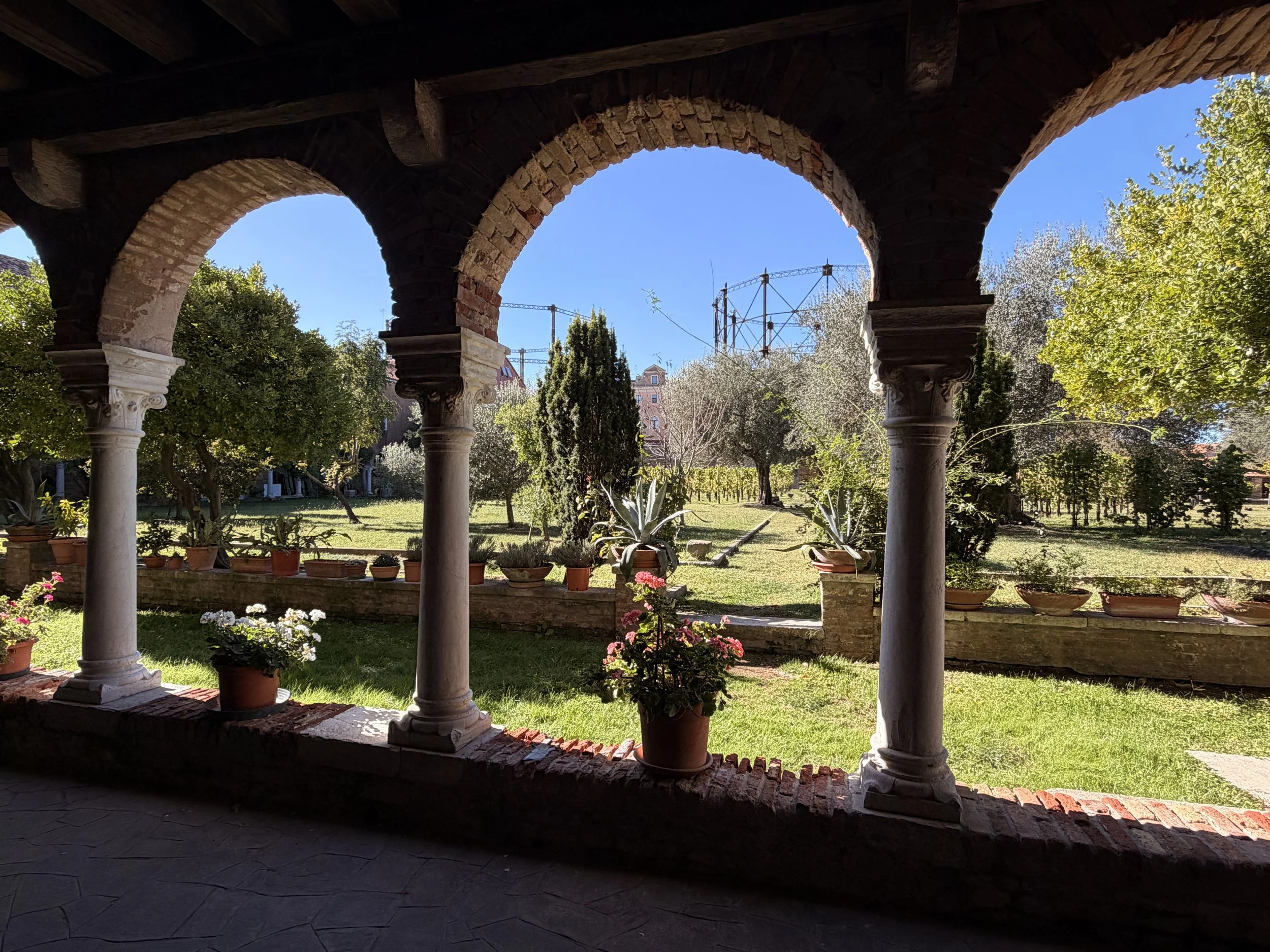
In 1253, a Venetian nobleman, Marco Ziani, left his vineyard to the Franciscan friars. They built their convent on it, and the church that stands here now, with its façade by Palladio, came three centuries later. You pass through a cloister of pink walls and white columns, a statue of Saint Francis at its centre, the campanile above. A second cloister opens, and there they are. Rows of vines among olive trees and cypresses, terracotta pots of lavender and geraniums along the low brick walls.
There are 1,107 vines today, Glera and Malvasia Istriana, replanted in 2019 and worked by hand.
Then you look up. Above the rows stand the iron skeletons of the old gasometers, rusting against the sky. A medieval vineyard, and an industrial ruin keeping watch over it.
The wine made here is called Harmonia Mundi. The name comes from a treatise by Francesco Zorzi, the friar who advised on the church's proportions.
Its story has a Veronese thread. A few wine lovers from Verona visited the convent and helped the friars see what they had. The first vintage, 2014, was a Teroldego, made by Celestino Gaspari of Valpolicella.
Today Santa Margherita tends the vineyard and makes a sparkling wine from it, in a small numbered edition.
Before we leave, I always tell my guests that this vineyard is one piece of a much larger story. Venice still has vines hidden behind walls, in convent gardens and quiet courtyards, and more out on the islands of the lagoon. Most visitors walk past them without ever knowing.
Those hidden vines are what is left of a city that once traded wine across the Mediterranean on a scale few rivals matched. I'll come back to that story another time.
A practical note: the convent is a working religious house, and the vineyard is not always open. Ask at the convent before you go.
Sources